
On Suffering & Meaning.
The synthesis of two seemingly polarized subjects, unified in divine love

I. Background
For the better part of six years, I have been working as a Chaplain, peering into the eyes of patients undergoing tremendous and wide-ranging suffering. I’ve witnessed everything from motor vehicle accidents, stab and gunshot wounds, and suicide attempts to heart attacks, debilitating diseases, and strokes. I’ve seen children die and the least likely people end up living, some of them readmitting again and again from self-inflicted harm. I’ve held the grief of young parents faced with stage-4 cancer diagnoses and the hands of those departing to the next life. I’ve baptized infants who wouldn’t live to see another day and married couples whose last request was to spend their remaining hours with their betrothed.
In the wide array of suffering, not only was there seldom a commonality but more often than not, the suffering appeared seemingly at random—dished out to some and not to others for no other reason than mere bad luck. This observation was shared routinely by my patients, who, in their sorrow, began to inspect their lives in hindsight, searching desperately for a potential answer to the pain. Surely something had caused this, some misstep or unwillingness to align with the Almighty had endowed them with a firm hand and no mercy. But often, such a reasoning was never found. As such, many surrendered to it, deducing to a state of complacency. Others, however, longed for control of some kind—a handle to hold onto that at least provided stability as the waters crashed around them.
I thought I could describe a state; make a map of sorrow. Sorrow, however, turns out to be not a state, but a process. It needs not a map, but a history, and if I don't stop writing that history at some quite arbitrary point, there's no reason why I should ever stop.1
- CS Lewis
In the experiences I’ve shared with many, it has become increasingly evident that suffering does not follow any rhythm and definitely does not discriminate. It does not care whether you are two minutes or ninety-seven years old; if the heart within you is beating, odds are, you are not only susceptible but are eventually going to go through, suffering. It is as close as a shadow and no further than a breath.
Suffering comes for us all.
Through my vocation, I have observed a surprising revelation: many who endure profound suffering develop a sense of (or a will toward) meaning. This often leads to unexpected responses to immense pain, such as finding peace, clinging to hope, or even experiencing joy. Moreover, suffering seems to offer insight, regardless of its intensity. While the weight of pain and loss can strip away almost everything, something enduring always seems to remain, a spark capable of carrying a person through even the darkest moments.
However, even more fascinating was the realization that one does not appear to merely will for meaning in their predicament, but meaning derives itself fully in the very presence of (and perhaps not limited to) suffering. For many of the patients or families of the patients in my care have told me, meaning seemed to come almost instinctively, when it was least probable and almost entirely unexpected. Viktor Frankl, holocaust survivor, Australian Neurologist, Psychologist and inventor of the study of Logotherapy concurred with this observation stating, “Will cannot be demanded, commanded, or ordered. One cannot will to will. And if the will to meaning is to be elicited, meaning itself has to be elucidated.”2
So the questions remain: what causes meaning? What is the purpose of suffering? What is the relationship between two subjects that appear to be polarized? Is there a supernatural force at play?
This essay explores the relationship between suffering and meaning, examining how our Western approach to pain often dismisses the profound impact it can have on the human experience. Pain is not a virtue to be sought after, nor is it inherently good. However, in its presence, many of the constructs that divide us—status, privilege, and earthly relativity—are stripped away, unveiling a deeper sense of meaning and enlightenment. This awareness exists beyond the intensity of the suffering itself.
This truth is the greatest wisdom I have learned in my work as a Chaplain. My hope is to explore this subject with care, offering you, the reader, a perspective that may bring hope in moments of suffering; whether you face them now or encounter them in the future.
II. Love As Foundation
I was assigned a patient who resided with his sister in her home a few minutes south of town. For hospice care, he was incredibly young; only 66 when he admitted. He had Down syndrome and, after a hefty ten-year battle with Dementia and acute Pneumonitis, had yielded to palliative care, opting for home hospice. This family was particularly low-income, residing in a very small estate on the edge of town where they lived as relatively simply as they could. The sister had retired from her full-time job fifteen years prior and immediately became a caregiver for her brother after he received his Dementia diagnosis and had nowhere else to go.

She gave everything she had—including the luxury of retirement—and asked nothing in return. The government passed a state-regulated law allowing her some meager pay for her efforts, just enough to keep the lights on. But for the first decade, she served her brother tirelessly without any expectant compensation.
I finally met these people one sunny afternoon, walking up to the front door that hung oddly on rusted hinges while rotted house siding slapped in the wind. The sister, Jolene, had cleared a spot next to her brother, Geoff so I could meet him. Two big blue eyes and a grin that was as contagious as dawn spilling light across the horizon met me. He completely beamed from ear to ear, while his leg rested cattywampus off the recliner.
I learned Geoff loved John Cena and Elvis, dancing in the kitchen, and eating anything he could get his hands on. I saw pictures of him hanging out the side of Jolene’s old car window with his tongue sticking out and him resting in the middle of her tomato garden in his wheelchair beaming with the same toothy smile he gave me that day I met him. I learned that Jolene loved to cook and collect antiques and make the most of the day, even if that was just a warm cup of coffee and a hug. No matter what, she had her Geoff, and that was enough of a reason for her to smile.
I visited Jolene and Geoff every week, sitting in the living room as we laughed, cried, and spoke of God’s blessings displayed daily, in the simplicities of life often missed. They had almost nothing and yet somehow seemed to have everything. It was a miracle wrapped neatly before my eyes that I slowly began unraveling as I witnessed the profound hope and joy in the unlikeliest of places. Instead of retirement, Jolene surrendered all to care for her brother. Instead of money, Jolene and Geoff had each other. Instead of a grand house, together they created a tidy space to call home.
Even as Geoff’s health began declining steadily over the course of months, the assured energy never seemed to change. In fact, it deepened. Prayers became more intentional. Laughter became medicine. Our friendship forged in faith became the cornerstone that lifted our spirits as the walls of grief seemingly caved in around us, because what we shared was far greater than any earthly suffering.
And then one day, Geoff passed away. I was fortunate to have received the notice that he had gone unresponsive hours before and had the opportunity to pray for him over speakerphone mere moments before he took his final breath. When Jolene called me back to tell me Geoff was gone, though there was heavy aching grief, she described to me an even greater peace, a conquering resonance that rooted deep within her spirit, letting her know all would be well. (For those interested, I wrote about Geoff’s funeral service here).
But those who hope in the Lord
will renew their strength.
They will soar on wings like eagles;
they will run and not grow weary,
they will walk and not be faint.
- Isaiah 40:31 (NIV)
My time with Geoff and Jolene was a profound lesson in living amidst grief. It wasn't their grit or willpower that amazed me, but the quiet grace they carried. Their posture wasn't born of their own strength, but from a wellspring of supernatural peace that flowed within them, a life-giving current amidst the withering tides of exhaustion and disease.
A current comprised of overflowing and unending love. Love changed the story. Love held the pieces together. The circumstances were less than favorable, but nothing could steal their love.
Their love rose from the ashes, blossoming above their adjoined grief and misfortune, producing a sense of rich color to the otherwise greyscale landscape. Talking with Jolene after the funeral, I asked her how she was able to care for her dying, handicapped brother for almost 20 years without breaking.
Her response? While the work was backbreaking and the uncertainty of the future depressing, she would do it all again for the sake of her brother whom she loved so dearly. The sleepless nights, the behavioral tendencies, the physical work of carrying him back and forth to the bathroom and adjusting him in his recliner, the emotional strain of watching him steadily grow weaker and weaker, the haunting grief around every corner, all of it.
Jolene wasn’t alone in that sentiment. In Tim Keller’s, Walking With God Through Pain & Suffering, he references Andrew Solomon who, in his book, shares about two parents who are shocked when they gave birth to a child who is very different than they were—born deaf, a dwarf with Down syndrome and autism along with being routinely chronically ill. Despite this, they seemingly grow closer and stronger through the difficulties presented to them and end up acquiring a foundational sense of meaning far greater than had they never gone through the experience. Solomon then shares about many other families in similar situations, summarizing his findings by stating, “This book’s conundrum is that most of the families described here have ended up grateful for experiences they would have done anything to avoid.” (Solomon, 2015, as cited in Keller, 2016, pp. 71–72)3
Keller goes on to analyze how suffering rooted in love tends to lead to spiritual revelations, understanding that at the core, love reveals that we are more than the accumulation of bones and flesh; we also have a soul that longs for connection and meaning.4 This transformation perspective separates oneself from the present tribulation, rising above the current happenstance into the divinity of God, who regards His creation with pure, unfiltered, everlasting love. The pain and sorrows of hardship don’t cease to exist, but rather the alignment with the divine provides sustenance to see beyond, giving clarity and depth to the present pain.
Grief is the inevitable shadow of love, a testament to the depth of our affections. We grieve deeply because we have first dared to love deeply. And in this, love reflects the intentional heart of Jesus—He who walked through grief, bore its weight, and triumphed over it with a love that is unblemished, unyielding, and boundless.
Thus, love triumphs in suffering, inviting us back into the everlasting arms of Jesus, a supernatural force that gives us the fortitude and stamina to endure suffering, even as tears roll down our faces.
“The world is indeed full of peril, and in it there are many dark places; but still there is much that is fair, and though in all lands love is now mingled with grief, it grows perhaps the greater.”5
-J.R.R. Tolkien
III. Meaning As Transcendence
A firm, foundational perspective of meaning has the authority to transcend affliction, as evidenced by the countless people I have observed in my care over the years. This isn’t to suggest that suffering loses its severity or that somehow its presence doesn’t sting, but that those who derive a sense of meaning tend to fare better and have increased stamina when life inevitably gets difficult.
It is quite peculiar to observe occupied hospital rooms, for, in them is an unspoken aura, an energy that is noticeably recognizable. I don’t have the ability to articulate what I mean in grand detail besides to say that it is quite easy when entering a room to recognize if it is tense or relaxed, depressive or optimistic, hopeless or hopeful. This atmosphere often mirrors the emotional and spiritual state of those within it.
Ultimately, it is the meaning we assign to our circumstances that shapes how we endure them. Even in the face of unbearable suffering, if one clings to a purpose greater than the present pain, they may discover the key to a peace that transcends understanding; a hope that renews their strength and grants them the endurance to press on.
“The one thing you can’t take away from me is the way I choose to respond to what you do to me. The last of one’s freedoms is to choose one’s attitude in any given circumstance.”6
I’d like to suggest that such meaning must be rooted in a firm foundation of love. Whether that be spiritual love, relational love, or intimate love, love itself is the entity that guides meaning, providing a grand scale hope that exceeds the size of the pain. If the pain is larger than the aforementioned perceived meaning, it becomes entirely guaranteed that hopelessness and desuetude will ensue.
Towards the end of summer, I was assigned to meet with a patient and his wife who resided on a small-acre farm just outside city limits. After driving for miles on unpaved gravel roads trying to locate the property due to poor cell reception and blowing dust, I spotted a quaint white house sitting among farming equipment and split-rail fences. A golden lab sat on his haunches utterly beaming as I made my approach, finally bounding up on me as I exited my car.
A slender gentleman that I will call “M” greeted me at the door. I noticed a very small lump under his right ear but warranted it insignificant as he shook my hand and welcomed me into his home. Initially, I assumed he was leading me inside to meet another man—the patient I had come to see. Only later did I realize that he himself was the one entering hospice care. He shared that he had noticed the same small bump that I had a month prior and had been told that he had severe lymphoma, causing the lymph node on his neck to swell larger and larger over time. He opted out of radiation or preventative care, telling me that he wanted to “enjoy what time he had left loving his wife and tending to his farm”.
M had resided at this farm his entire life, working on it with his father until he passed away, and M took it over. M reconstructed the house, maintained the farm, and even did all of the equipment repair and maintenance himself, all while continuing to tend to livestock, including cattle, chickens, and sheep. Later in life, he met his wife, whom I will refer to as “L,” and together, they made the farm a quiet place to call home. M and L did everything together and thoroughly enjoyed each other’s company. The back wall of their home was adorned with countless picture frames, each handmade by M, showcasing dozens of cherished photos of family members, close friends, and moments of M and L laughing together. In truth, every corner of their home was a testament to joy, mementos of life and love. The front door had been salvaged from L’s childhood home. Wooden furnishings were meticulously crafted by M’s own hands. Scribbled drawings and heartfelt letters from children adorned the shelves, alongside trinkets collected during their travels. On the dining room table sat a small wooden heart, a keepsake M had given to L when he proposed—a symbol of love woven into the very fabric of their home.
I visited them weekly and we discussed life and God and hope together, even as M’s tumor continued to grow, steadily becoming more and more noticeable. However, he continued to sit in the recliner next to his wife, the warmest smile upon his face as he told me, “I have everything I could possibly need: the love of my wife, my farm, and my Lord.” After saying this, he would always reach for L’s hand which he’d hold for the remainder of my visit.
M’s joy was contagious. Nothing could steal it. No pain could contain it. Eventually, his mass grew so large that it became impossible for him to blink his right eye, his face so puffy and sore that it had almost a mauve hue to it while his speech became increasingly muddled. Then he lost almost all hearing. Even so, M smiled radiantly, holding his beloved’s hand in his as he watched me without words.
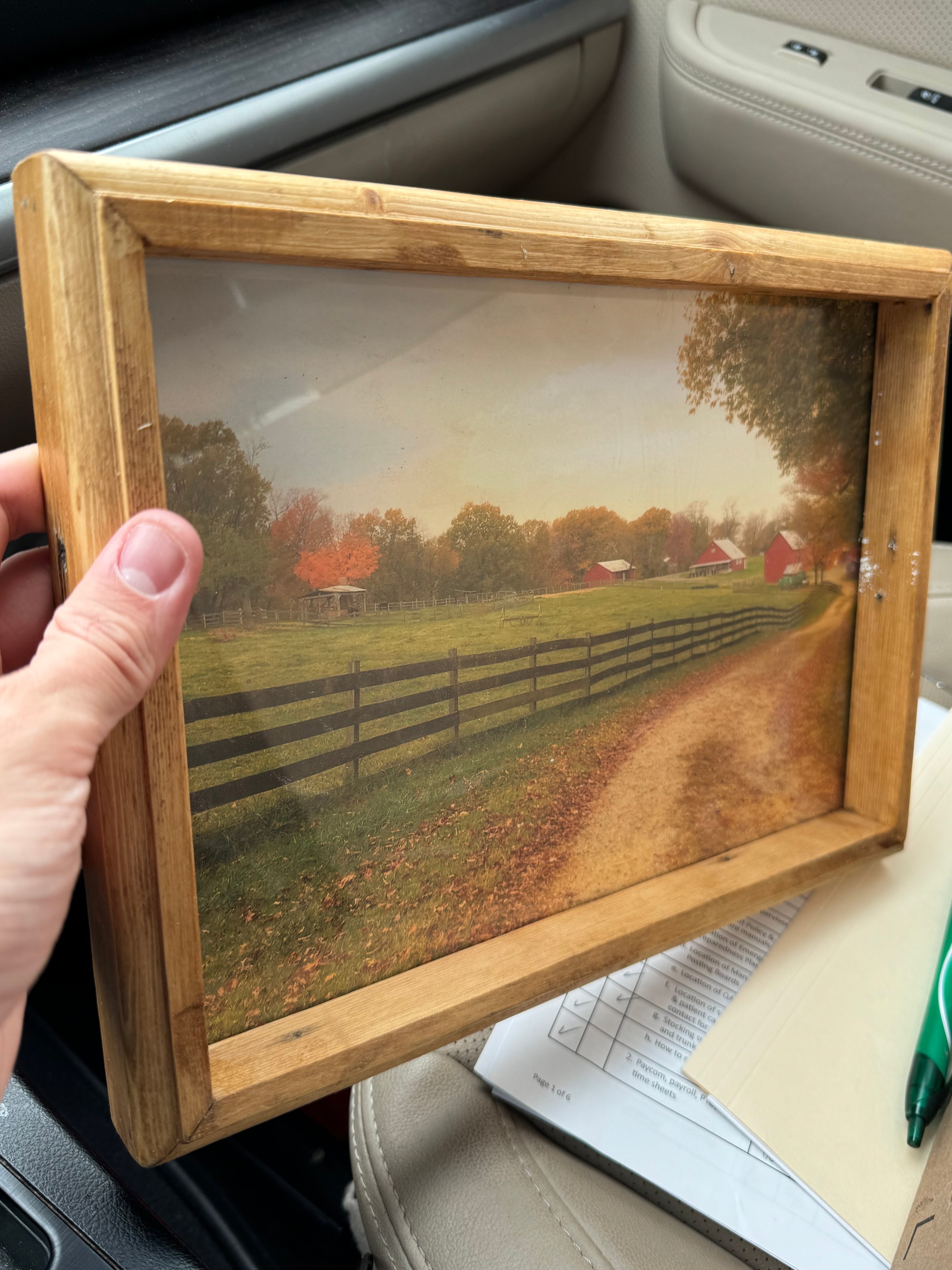
M died on Christmas morning. I officiated the funeral yesterday. A week before M died, he gave me a picture frame for me to have, so that I would always remember him and the peaceful tranquility of the farm (I mention this picture frame here, but will also attach the picture below).
At his funeral, it only seemed fitting to preach on the impact of the Christmas story and how Jesus was born into our darkness to shine his light directly into it. There was no darkness Jesus Himself was afraid of. Through Jesus, we witnessed the very heart of God, who mourns with us as we mourn, hurts with us as we hurt, and yet offers meaning and hope that triumph over any pain we may face on this side of eternity. I tied in M’s life to this, stating that his life was a testament to the divine love and meaning he had derived from Jesus, and that even though he had faced terrible agony and grief as his cancer overtook him, nothing could possibly take him from God’s love. A love that radiated in his heart proudly, till the end.
IV. A Theology of Suffering

As alluded to in the previous sections, the actualization of suffering as transcendence does not provide the key to meaning; it is only the result of a much larger source. Hence, meaning cannot be willed willingly, or equipped consciously. Instead, it reveals itself in moments of pain in an almost supernatural manner.
I’d like to make the argument in this section that meaning is tethered to a theology centered on and comprised completely of, love. We love because we have known love, at the beginning of time we were called love. Henri Nouwen writes, “When we are not afraid to journey into our own center, and to concentrate on the stirrings of our own souls, we come to know that being alive means being loved. This experience tells us that we can only love because we are born out of love, that we can only give because our life is a gift, and that we can only make others free because we are set free by the One whose heart is greater than our own. And when we have finally found the anchor place for our lives within our own center we can be free to let others enter into the space created for them, and allow them to dance their own dance, sing their own song, and speak their own language without fear. Then our presence is no longer threatening and demanding, but inviting and liberating.”7
“For God so loved the world that he gave his one and only Son, that whoever believes in him shall not perish but have eternal life.”
- John 3:16 (NIV)
The issue is, I think, that meaning in Western society can be subconsciously tied to a self-centered view that we deserve happiness, health, and freedom. “The Pursuit of Happiness” demonstrates this flawed philosophical idea. However, this couldn’t be further from the actual truth. As displayed through a theological lens, meaning through love always requires sacrifice; the sacrifice of wants, the sacrifice of needs, the sacrifice of safety, the sacrifice of convenience, and sometimes even the sacrifice of self.
Jesus Himself—the very son and majesty of God—laid down His own life to achieve something radically profound: to vanquish the clutches of death by willingly surrendering Himself to it, turning death on itself and triumphing through resurrection power. It was unheard of and quite frankly, obscene that the creator of the universe would willingly do such a thing.
But the death of Jesus also reinstated a very important and sobering reality: meaning does not equate peace. Meaning does not equate comfort and happiness. In fact, the essence of love and meaning may actually toss us into situations where comfort and happiness are furthest from us. Therein lies the importance of where the authority is placed; in situational hardship, or in the grandeur and majesty of God’s love and promise to one day “wipe the tears from their eyes”.8
Years ago, I was paged to the Emergency Room to meet with the family of a young man who had been involved in a farming accident. According to the report, as he was doing morning chores, he heard screaming coming from one of the grain silos on their acreage. Acting quickly, he climbed up the side, propped open the lid, and was shocked to find his father trapped within. He then did all that he could to help his father out, eventually falling in himself where he was quickly and completely smothered.
By the time help had come, this young man had sunk into the grain and was minimally responsive. He perished soon after arriving to the Emergency Room, while his father ended up living, being discharged a couple of days later. The young man was honored as a hero, willing to lay down his life for the sake of saving his father. In a profound act of bravery, he sprung to action, not giving any substantial thought to the stark reality that more than half of all grain silo mishaps result in a fatality (the percentage rises dramatically once one actually falls into a silo)9. All he knew was that his father needed help, and he was willing to do whatever it would take to save his life.
The family’s grief was intense and overwhelming, yet within it lay a broken hallelujah—a bittersweet gratitude that they had loved and raised a man of such sacrificial nobility. They resolved not to let his sacrifice lose its meaning but to honor it through their own lives, willingly loving and serving others. Out of the ashes of their loss rose a profound and revelatory pride, tempering the weight of the impending sorrow. Together, we reflected on the crucified Messiah, who hung on the cross; the perfect sacrifice so that we might live.
V. Conclusion
I do suppose that God allows suffering in some capacity because of His divine understanding of the world and its nature contrary to our finite and tunnelvisioned minds. I have to believe when I read scripture such as the book of Job, that God does actually have a purpose for suffering and that there are different types of suffering that we will face on this side of eternity.
However, I don’t believe that God always wills for tragedy, death, devastation, and conflict to take place, as it is only a representation of the condition of the world we live in, a world that has been cursed with sin until the return of the Messiah. It is the very essence of God’s own heart manifested in us when we cry out Why Lord? when we witness injustices of any kind.
Despite this, we worship a God who works all things together for good, including our hardship. When we face suffering of all kinds here, God Himself offers his presence with us.
The beauty of having our meaning rooted in faith through suffering is that we can hold onto the hand of hope, even in our deep, consuming agony. That we see in Jesus an answer to the book of Job and the pain we will face in our own lives: the very being of God is not one who delights in our suffering, but feels them fully on the cross (Luke 23). The very being of God is not stoic in the face of death, but is moved to tears while offering healing (John 11). The very being of God is not distant from those who mourn, but draws near to give comfort (Matthew 5).
We may not always know the source of the suffering, but I can assure you, we know in the bleeding hands of Christ that suffering will never get the final say.
Lewis, C. S. (2016). A Grief Observed. Crossreach Publications. (Original work published 1961).
Frankl, V. E. (2014). The Will to Meaning: Foundations and Applications of Logotherapy. Plume. (Original work published 1969).
Keller, T. (2016). Walking with God through Pain and Suffering. Penguin Books.
Ibid., p. 73.
Tolkien, J. R. R. (1954). The Fellowship Of the Ring. George Allen & Unwin.
Frankl, p. 86.
Henri J M Nouwen. (1979). The Wounded Healer. New York Doubleday (An Image Book), pp. 97-98.
Revelation 21:4, NIV.
The crushing truth about grain bin mishaps and how to survive. (n.d.). Farm Progress. https://www.farmprogress.com/corn/life-threatening-grain-bin-encounters.
Excellent! There is a beauty in suffering which is far too often ignored in today’s Christianity. Some of my most precious times with God were times of suffering when I realized the depth and magnitude of His love and grace toward me.
This is filled with powerful reminders. Even as I look at my own life, shadowed and torn by immense suffering, there is some measure of meaning and hope there that was not initially there. Somehow, there are those who see past their pain to something or someone greater. And that is where the most comfort is found in suffering.