
Ashes to Ashes, Dust to Dust.
Speaking of Eternity: A Conversation Between Generations at a Graveside

How do you talk to your child about death? I wish I knew. I find myself struggling to discuss it with older populations as well; the mysterious, seemingly unnatural finale of one’s life leaving those in its wake pondering their own mortality knowing they too will one day be unable to escape its claim.
Despite its prevalence, I must admit that it does feel like a rather peculiar thing. One moment, the departing is still there; alive and with you, the next they take their last breath… and you don’t. You’re left breathing, left behind, forced to reconcile with the sobering reality that you will never actually see them again in this life. Never hear their voice. Never make more memories.
Gone.
Silent.
Cold.
Even in the hope of eternal life, the weight of grief is one often heavy to bear, the empty chair at the table an absence that will be felt until the vitality of our own time reaches its completion. It is in this sacred, transitory paradox that we come to understand: joy and grief do share communion. Nowhere is that truth more deeply felt than in the gathering of believers at a funeral service.
“But our citizenship is in heaven. And we eagerly await a Savior from there, the Lord Jesus Christ, who, by the power that enables him to bring everything under his control, will transform our lowly bodies so that they will be like his glorious body.”
- Philippians 3:20-21 (NIV)

The day felt ripe for a funeral; the sky etched in blankets of deep silver clouds layered above wisps of white that traced the wind as far as the eye could see. Rain fell like solemn teardrops from heaven, pounding upon the white church steeple as though God Himself had announced today a day of grief — and yet, of hope.
The subject of our gathering a remarkable woman; my wife’s grandmother, Alida. A beacon of faith, whose life was woven with quiet wisdom, gentleness, and grace left an indelible mark on all who knew her. She knew the Lord deeply and had been patiently awaiting the day when she would finally see her Jesus (and her late husband) face-to-face. It was a joyful thought; one that brought many a tear and smile upon each face as we all mingled (and us parents chased after our children) during the visitation and finally the actual funeral processional.
Alida had become a grandmother to me, a dear friend and grandmother to my wife, and an exceptional great-grandmother to our children. As we sang old church hymns to the heavens early in the service, there was a collective harmony in both song and spirit, one thanking God for a life well lived, a life eternal, and the cherished gift it was to have the opportunity to know and love one of His most magnificent creations.
At last came the eulogy. And while my two-year-old son delighted in doing what two-year-old boys do best during formal gatherings, squirming under pews and ignoring every whispered plea to “sit still!” or “be quiet!”, my daughter’s posture was markedly different. Something inside her stirred, an inkling of the change that lay before her eyes.
For weeks leading up to Alida’s passing, my wife and I had had many gentle conversations with our daughter about death, the dying process, and the good news for all those who believe. Much of these talks were first invited by my daughter as she witnessed, through innocent eyes, the steadily decline of her great-grandmother.
Since my wife and I had married, we regularly attended what her family lovingly calls “Sunday lunch” at Alida’s home, where we shared a meal and laughter after the conclusion of our morning church services. These gatherings became a rhythm in our lives, a familiar setting where love was served as often as the food. The dishes nourished our bodies, but it was the people around the table who nourished our souls.
But over time, subtle shifts with Alida began to appear. One Sunday, she seemed more confused than she normally was. A few Sundays later, she struggled to rise from her chair. Then one Sunday, she slept through nearly the entire meal.
Naturally, it didn’t take long for our children to begin to observe the changes unfolding before them, and we found ourselves having to explain in very tangible words something that was wholly intangible, dying.
I’ve always been a proponent of honesty with children, of speaking plainly and tenderly about the truths of life, both the good and the hard. I believe in giving them space to process, question, and feel deeply, while assuring them they are safe in doing so. These early lessons, I believe, nurture emotional and spiritual maturity; a framework for understanding the weight and wonder of being alive that can grow with them into adulthood. Softening the blow is simply not an option, not when their great-grandmother will be missing from our weekly gatherings for the rest of their lives.
Early in the afternoon, we reached the cemetery. A cortege of dark umbrellas made their way to a large baby blue tarp stationed just outside the burial plot, a gravestone firmly placed at the end of the wide, open grave layered with two iron beams for the casket to be placed onto. I was one of the six pallbearers, tasked with guiding Alida’s body to her final resting place in the earth.
Ashes to ashes, dust to dust.

The committal was brief, the hope palpable. The pastor made closing remarks of the spiritual reality that Alida’s soul was no longer with us, but in heaven where she was finally free from the ailments and aches of this world. That even as we prepared to lower her body to the ground, we should be reminded to look to the heavens and hold fast to the hand of love that will one day guide our own souls home. It was heartfelt, spirit-filled, and quite beautiful.
As the final scriptures were read and prayers were prayed, we turned to leave.
My daughter didn’t move.
“No daddy! Please, no!” She cried.
I knelt beside her.
“Dad, I want to say goodbye to grandma!”
I carried her to the casket.
She stretched out her small hand, fingers trembling as they reached for the oak, yearning for one last touch, one final connection. “Goodbye grandma, I love you.”
She turned to me, trying to hold it together as the tears traced my face.
“Is heaven inside the box?”
I chuckled. “No, honey. Heaven is so much larger than the box. That is only holding grandma’s body now. Grandma’s soul is with Jesus, in a space that is so so big! Where grandma can run and dance and sing forever. You’ll see, someday.”
A day later, my daughter was seen drawing a picture at our kitchen table.
Curious, I asked what it was.
“This is a picture I made for grandma Alida. I’m going to keep it with me until I am really old and one day when I go to heaven, I am going to bring it with me so I can give it to her.”
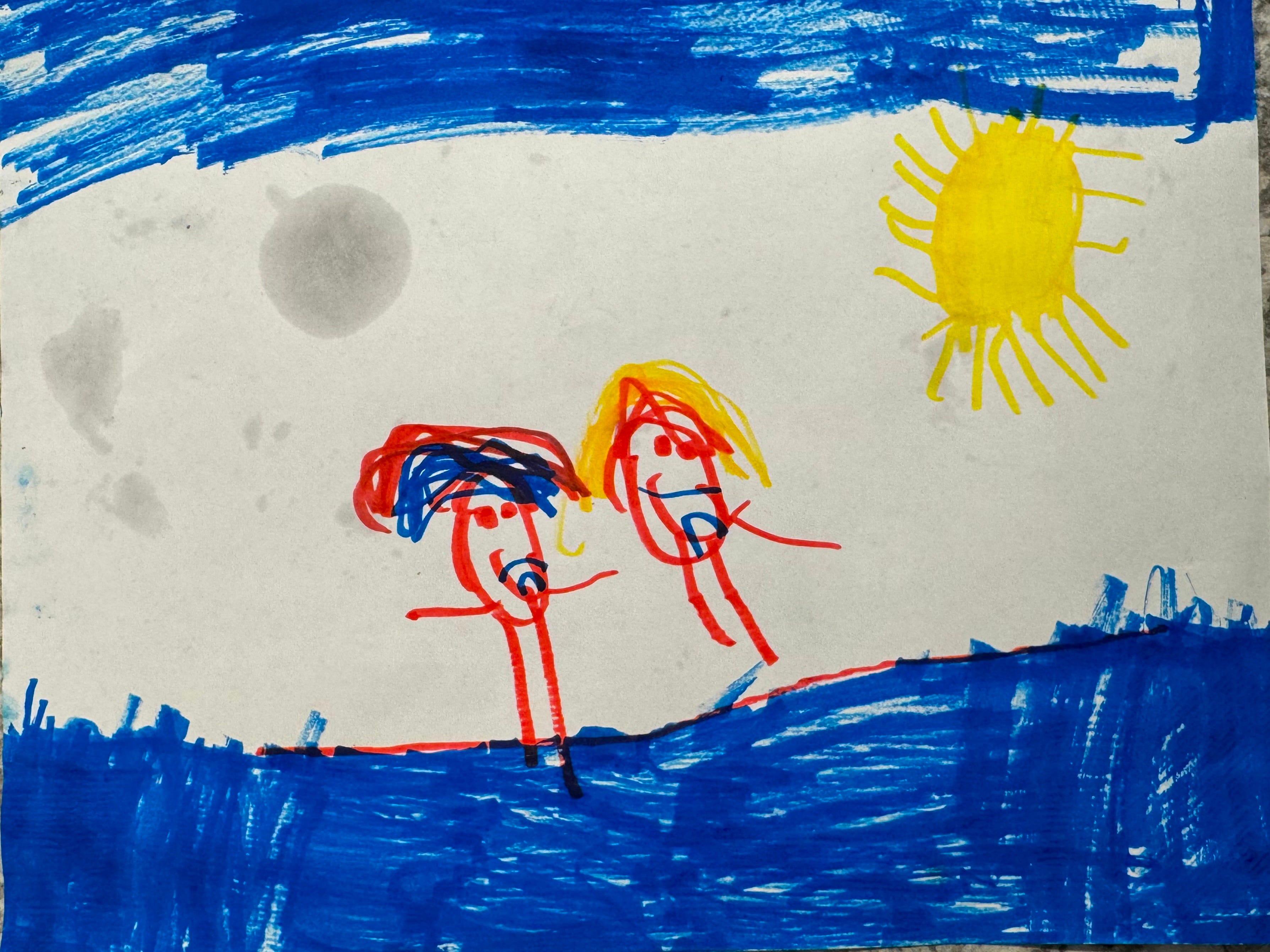
I don’t suppose there’s ever a proper way to meet death — no fearless gaze steady enough to hold its face.
But this I know:
Even in the ache of unanswered questions,
in the fog of doubt and the hollow of sorrow,
in the wandering silence and the weight of goodbye—
there rests a quiet joy,
woven into the hearts of all who trust in Jesus.
And sometimes, that message arrives
not clothed in eloquence or wrapped in reason,
but spoken soft and sure—
through the trembling lips of the young.
Beautiful ending! Thanks for sharing, Devon. Hope your daughter enjoys reading this later in life.
Man, I almost cried with this one...
So sorry for your family's loss Devon. <3
Thank God for His hope!